CBD oil and essential oils: what each one is, and whether to mix them
People search “CBD essential oil” as if it’s one product. It isn’t. CBD oil is a cannabinoid extract from hemp dissolved in a carrier oil. An essential oil, like lavender or peppermint, is the concentrated aromatic fraction of a plant, usually steam-distilled. They do different jobs, they have different evidence, and only one of them belongs under your tongue. So the short answer: you can combine CBD and essential oils on your skin, diluted and patch tested, but never add essential oils to CBD oil you swallow, and a diffuser won’t deliver CBD at all. If what you actually want is CBD plus a cooling plant ingredient on a sore joint, there’s a ready-made option further down that skips the mixing.
I’ve had rheumatoid arthritis since I was 15, more than 30 years, and I take CBD oil every day alongside my prescriptions. Here’s how the two kinds of oil actually differ.
CBD oil is not an essential oil
The word “oil” is doing a lot of confusing work here.
| Essential oil (lavender, peppermint, ginger) | CBD oil (e.g. our 2800mg broad spectrum) | Reclaim Labs NANO CBD roll-on | |
|---|---|---|---|
| What it is | Volatile aromatic compounds from one plant | Hemp extract (CBD plus minor cannabinoids) in a carrier oil | Nano-emulsified CBD gel with menthol, arnica and aloe |
| How it’s made | Usually steam distillation or cold pressing | Extraction, then dilution in a carrier | Formulated for skin |
| Swallow it? | No. Some are toxic by mouth | Yes, under the tongue | No, skin only |
| Straight on skin? | No, dilute first | Possible, but it’s dosed and formulated for oral use | Yes, that’s what it’s for |
| Joint pain evidence | Small massage trials, short-term effect | Topical CBD: one small RCT in thumb arthritis | No trial of this product |
| Main risk | Allergic skin reactions; poisoning if swallowed | Drug interactions when taken by mouth | Skin sensitivity to menthol; trace THC |
The overlap is terpenes, the aromatic compounds that give essential oils their smell. Hemp makes some of the same ones, like linalool (lavender) and limonene (orange peel), and broad and full spectrum CBD products keep some of them. A few terpenes don’t make CBD oil an essential oil, though.
What the evidence says about essential oils for joint pain
Real, small, and shorter-lived than the marketing suggests.
Nasiri et al. 2016 (PMID 27863613) randomized 90 people with knee osteoarthritis to lavender oil massage, massage with plain almond oil, or no massage. Pain in the lavender group dropped significantly right after treatment and one week later compared with no massage. By four weeks, the groups were no longer different.
Yip and Tam 2008 (PMID 18534325) tested a massage oil with 1% ginger and 0.5% orange essential oil in 59 older adults with moderate to severe knee pain, against the same massage with olive oil and against no massage. One week after treatment, pain and physical function were better in the ginger and orange group than in both comparison groups. That advantage was gone at four weeks.
Two things to take from those. First, the effect is real but short: think days, not months. Second, the concentrations were low. The ginger and orange trial used 1.5% essential oil in total, not a few neat drops rubbed onto the knee.
Arnica isn’t an essential oil, but it’s a plant topical with a larger joint trial behind it. Widrig et al. 2007 (PMID 17318618) randomized 204 people with hand osteoarthritis to an arnica gel or 5% ibuprofen gel for 21 days, double-blind. Pain and hand function improved equally in both groups, and the authors concluded the arnica gel was not inferior to the ibuprofen gel.
What the evidence says about CBD on the skin
Thinner, but encouraging. Heineman et al. 2022 (PMID 35637038) ran a randomized, double-blind crossover trial of a topical CBD cream (6.2 mg/mL in shea butter) against shea butter alone in 18 people with arthritis at the base of the thumb. Two weeks of twice-daily CBD improved pain and disability scores compared with the control arm, with no adverse events. It’s a small study in one joint near the surface, and I don’t stretch it beyond that.
For a deep joint like a hip, or pain in many places, oral CBD is the format that reaches it.
How to combine CBD and essential oils safely
If you want to make your own blend, here’s what I’d hold to.
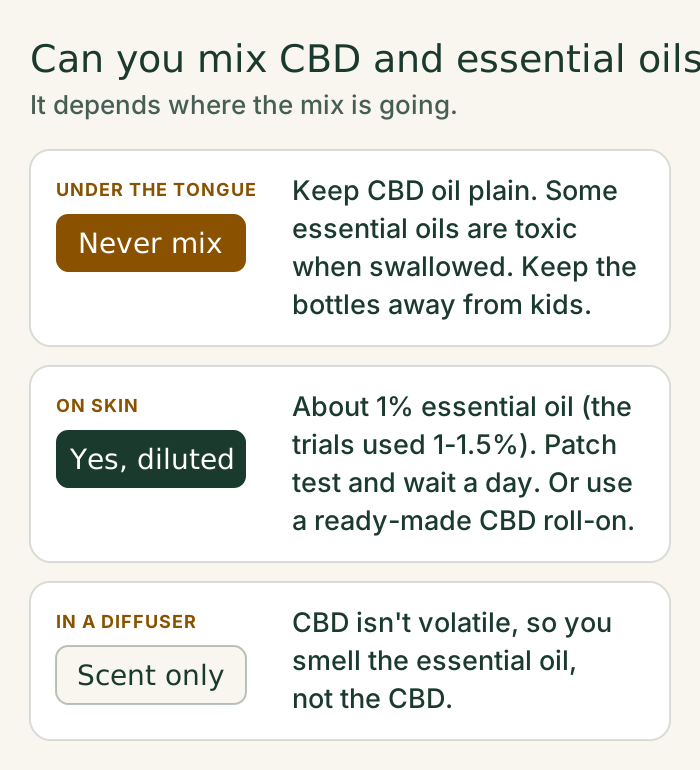
- Skin only. Mixing a few drops of essential oil into a CBD topical or a plain carrier oil for massage is fine. Adding essential oils to CBD oil you put under your tongue is not. Flaman et al. 2001 (PMID 20084213) reviewed 251 calls about children who had swallowed essential oils or products containing them; the most common symptoms were coughing and vomiting, two children had seizures, and the literature search turned up a death. Keep the bottles away from kids.
- Dilute. The trials above used 1 to 1.5% essential oil. Neat essential oil on skin is where most reactions start.
- Patch test. Barbaud et al. 2023 (PMID 37403438) described 42 patients with allergic contact dermatitis from essential oils they used themselves, mostly lavender and tea tree; 8 needed hospital care. Forty percent didn’t think to mention their essential oils to the doctor. Put a small amount on your inner forearm and wait a day before using a blend on a larger area.
- Skip the diffuser for CBD. A diffuser scatters volatile compounds. CBD isn’t one, so you’ll get the smell of whatever essential oil you added and very little else.
If you want CBD and a cooling plant ingredient in one step
Most people searching “CBD essential oil” want one specific thing: something plant-based to rub into a sore knee or shoulder that does a bit more than lotion. The DIY route means buying a carrier, a CBD product and an essential oil, then guessing at the ratio.
That’s the reader our NANO 1000mg CBD roll-on is for. It combines 1000mg of full spectrum CBD with menthol, which is the main cooling compound in peppermint oil, plus arnica and aloe. The CBD is nano-emulsified so it’s made for skin, not for under the tongue. It rolls on with no mixing, no dripping and no measuring, and it fits in a pocket.
What it isn’t: an essential oil blend, or a product with a clinical trial of its own. Nobody has compared it head-to-head with a lavender massage, and I won’t claim it beats one. Two honest notes. It contains menthol, so patch test it like any other topical if your skin reacts easily. And it’s full spectrum, with trace THC under the 0.3% federal limit; if you’re drug tested, our THC-free 50mg CBD patch is the safer choice.
How I navigate this
The CBD I take for my RA goes under my tongue: the 2800mg broad spectrum oil, half a dropper a day for the first two weeks, then a full 1ml dropper from week three. I take Prozac, lisinopril and metoprolol every day alongside it, and swallowed CBD is the format that raises the drug interaction question. Our CBD drug interactions hub covers the medications people ask about most.
I don’t expect a scent to treat inflammation. A week of relief from a massage oil is worth having, but it isn’t a daily routine.
Which one to use
- You want to relax, and you like the smell: a diluted lavender massage oil. Cheap, short-term relief in a real trial. You don’t need us.
- One sore joint near the surface (knee, hand, shoulder): the NANO CBD roll-on, which already pairs CBD with menthol and arnica.
- Pain in many joints, or deep joints like the hip: CBD oil under the tongue, starting low. Our titration guide explains how I’d start, and the joint and muscle hub covers the conditions.
- You want to make your own blend anyway: dilute to around 1%, patch test, keep it on skin, and keep it away from children.
CBD oil and essential oils can share a shelf. Just don’t put them in the same dropper.
Frequently asked questions
Is CBD oil an essential oil?
No. An essential oil is the volatile, fragrant fraction of a plant, usually steam-distilled, like lavender or peppermint oil. CBD oil is a cannabinoid extract from hemp dissolved in a carrier oil. Hemp does contain some of the same aromatic compounds, such as limonene and linalool, but CBD itself is not one of them.
Can I mix essential oils into my CBD oil?
On skin, yes, if you dilute the essential oil and patch test first. Don't add essential oils to CBD oil you take under the tongue. Essential oils are concentrated and some, like eucalyptus and camphor oil, are toxic when swallowed.
Can you put CBD oil in a diffuser?
It won't do much. A diffuser scatters volatile aromatic compounds into the air, and CBD is not volatile at room temperature. The scent you smell comes from the essential oil. If you want CBD in your system, take it under the tongue or use a topical or patch.
Do essential oils help joint pain?
Two small trials found short-term benefit. In knee osteoarthritis, lavender oil massage (90 patients) and ginger plus orange oil massage (59 patients) both reduced pain about a week after treatment, but the difference was gone by four weeks. Neither trial isolated the oil from the massage itself.
Products referenced in this post
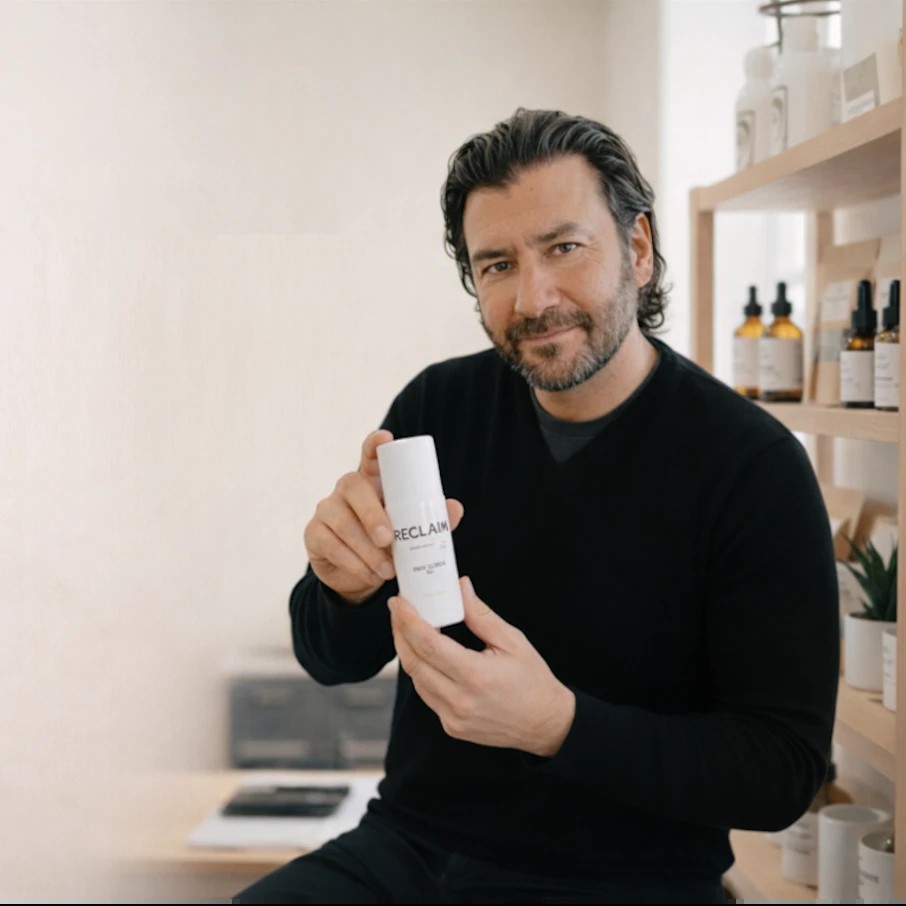
Founder of Reclaim Labs. Diagnosed with rheumatoid arthritis at 15, Ron spent 30 years navigating the medical system before self-formulating the broad-spectrum CBD oil that became Reclaim's flagship product. He reads the CBD-pharmacology literature closely and writes from lived experience, not marketing copy.