Pain patches for back pain: which type has evidence, and for which back
Pain patches for back pain fall into five types, and they aren’t interchangeable: heat wraps, capsicum (chili pepper) plasters, methyl salicylate patches like Salonpas, lidocaine patches, and transdermal CBD patches. The short answer on which works: for a back you tweaked this week, a heat wrap has the best evidence, better than ibuprofen in a head-to-head trial. For chronic low back pain, a capsicum plaster has the strongest placebo-controlled trial. Lidocaine, the one most people reach for, has the weakest case. And if your back hurts every day and you already take an NSAID, steroids or a blood thinner, there’s a fifth option further down, a 24-hour CBD patch, built for exactly that reader.
I’ve had rheumatoid arthritis since I was 15, more than 30 years now, and spent many years on NSAIDs, Celebrex included, plus 23 years on prednisone. Here’s what each label says, and what the trials found.
The five types of back pain patch, compared
| Heat wrap | Capsicum patch | Salonpas Pain Relief | Lidocaine patch | Reclaim Labs 50mg CBD patch | |
|---|---|---|---|---|---|
| What’s in it | No drug; warms to about 40°C | Capsaicin (Salonpas Hot: 0.025%) | Methyl salicylate 10%, menthol 3% | Lidocaine 4% OTC, 5% Rx (Lidoderm) | CBD isolate 50mg, zero THC |
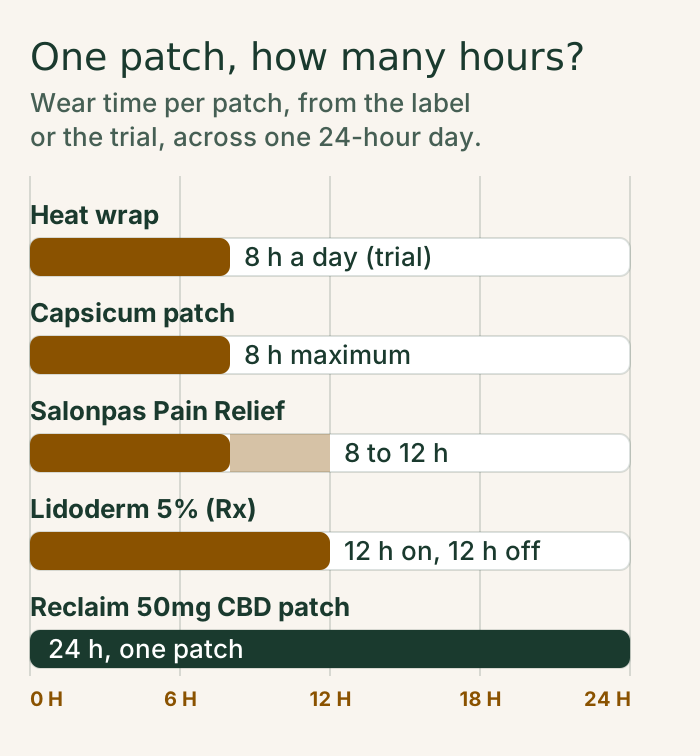
| How long one lasts | 8 hours a day in the trial | 8 hours maximum per label | 8 to 12 hours; max 2 a day, 3 days in a row | OTC: 3 to 4 times a day. Lidoderm: 12 hours on, 12 off | 24 hours |
| Best back pain evidence | RCT in acute low back pain, beat ibuprofen | Placebo-controlled RCT in chronic low back pain | Placebo-controlled RCT in muscle strain; lower back not studied | No convincing RCT | No back pain trials |
| Medication flags | None | Skin irritation | NSAID warning on label | Few | CYP enzyme interactions; tell your prescriber |
| Best for | A back you strained this week | Chronic low back pain, no other meds | Short-term muscle strain elsewhere | Surface, nerve-type pain | Every-day pain on top of a long medication list |
What the trials actually show
Heat wraps have the best evidence for acute back pain. Nadler et al. 2002 (PMID 12004166) randomized 371 adults with acute nonspecific low back pain to a heat wrap worn 8 hours a day, ibuprofen 1200mg a day, or acetaminophen 4000mg a day. The heat wrap gave more pain relief than both drugs on day 1 and on days 3 to 4, improved trunk flexibility more, and reduced disability more. A Cochrane review, French et al. 2006 (PMID 16641776), found moderate evidence that heat wraps give a small short-term reduction in pain and disability in acute and subacute low back pain. The American College of Physicians guideline, Qaseem et al. 2017 (PMID 28192789), names superficial heat as a first-line choice for acute and subacute low back pain, ahead of any drug.
Capsicum plasters have the best placebo-controlled trial for chronic back pain. Frerick et al. 2003 (PMID 14581111) randomized 320 people with chronic nonspecific low back pain to a capsicum plaster or a placebo plaster for 3 weeks. Pain scores fell 42% with capsicum against 31% with placebo, and 67% responded against 49%. Local skin reactions were more common on capsicum (7.5% vs 3.1%). The Cochrane review of herbal medicine for back pain, Oltean et al. 2014 (PMID 25536022), concluded that capsicum cream or plaster probably works better than placebo in chronic low back pain. One caveat: the trial used a European plaster, and I couldn’t confirm that any US capsicum patch uses the same formula.
Salonpas has a good trial, just not in backs. Higashi et al. 2010 (PMID 20171409), run by the manufacturer Hisamitsu, gave 208 adults with mild to moderate muscle strain one 10% methyl salicylate and 3% menthol patch or a placebo. The active patch gave about 40% more pain relief with movement over 8 hours. The sites studied were the shoulder, upper back, neck, arms, legs and abdomen. The lower back wasn’t on the list.
Lidocaine has the weakest case. Santana et al. 2020 (PMID 32189475) reviewed the 5% lidocaine patch for chronic low back pain and found no randomized controlled trials with substantial evidence for it, only uncontrolled studies. In a small double-blind trial, Hashmi et al. 2012 (PMID 22531485), 30 people with chronic back pain got a lidocaine or placebo patch, with no difference in pain. Half of each group reported pain down by more than 50%. The patch helped; the lidocaine added nothing measurable.
If your back hurts every day and you take other medications
Here’s the reader the table leaves out: back pain every morning, plus an oral NSAID, prednisone or a blood thinner already on the list. That was my profile for years. For that person, the shelf runs out fast. Salonpas adds methyl salicylate, and its label warns of higher stomach bleeding risk alongside NSAIDs, steroids and blood thinners. A heat wrap adds no drug, but covers 8 hours. Capsicum burns, and stops at 8 hours too. Lidocaine numbs the surface, and not much more.
That’s the gap our 50mg CBD patch is built for. It’s a transdermal patch: CBD isolate designed to cross the skin into the bloodstream and hold a steady level, rather than act on the skin underneath. One patch lasts 24 hours, so there’s nothing to re-stick at lunch and nothing that wears off at 3am. It contains no NSAID and no salicylate, so it adds nothing to an NSAID load you’re already carrying. It’s THC-free, which matters if you get drug tested, and waterproof enough to shower and swim in. Because it works systemically, it doesn’t have to sit on the sore spot; our page on CBD for back pain explains why that matters for deep back structures a cream can’t reach.
What it isn’t: a heat wrap you feel in ten minutes, or a proven back pain treatment. Nobody has run a trial of a CBD patch in back pain, or compared it head to head with Salonpas or a heat wrap, and I won’t pretend otherwise. It’s a tool for pain that doesn’t switch off, in someone who can’t keep adding drugs.
One safety point. CBD inhibits liver enzymes that clear other drugs, including CYP2C9, which clears warfarin. In Bansal et al. 2023 (PMID 37313955), a CBD-dominant extract with 640mg CBD raised exposure to a CYP2C9-cleared probe drug by 77% in 18 healthy adults. One 50mg patch is a fraction of that dose, but it’s still worth a line on your medication list. Tell your prescriber, especially on warfarin.
How I navigate this
I take Prozac, lisinopril and metoprolol every day, alongside CBD. I was on prednisone for 23 years and on methotrexate earlier in my disease history. So a patch with methyl salicylate gets the same question from me as an aspirin would: does my prescriber know? Our pages on CBD and NSAIDs and prednisone go into why.
On long days on my feet, like a multi-day conference, I put a patch on in the morning and stop thinking about my back. For everyday background pain, the 2800mg oil: half a dropper a day for the first two weeks, then a full 1ml dropper from week three. For one sore spot I can reach, the NANO roll-on.
Which patch to buy for your back
- You strained it this week, no other medications: a heat wrap. It beat ibuprofen in a trial and doctors’ guidelines put it first. Cheapest good answer on the shelf.
- Chronic low back pain, no other medications: a capsicum patch is worth a 3-week try. Expect some burning, and test it on a small area first.
- A pulled muscle in the shoulder or upper back: Salonpas Pain Relief has a trial behind it. Keep to the 3-day limit.
- Leg pain, numbness or weakness, or pain after a fall: see a doctor before you buy anything. Our post on spinal stenosis covers one common cause.
- Back pain every day, on top of an NSAID, steroids or a blood thinner: that’s the case for a 24-hour CBD patch, with your prescriber in the loop. Our guide to pain patches by type covers the rest of the shelf.
Read the active ingredients panel, not the box.
Frequently asked questions
What is the best patch for lower back pain?
For a back you strained in the last few days, a heat wrap has the best evidence: in a randomized trial of 371 people with acute low back pain it beat both ibuprofen and acetaminophen, and the American College of Physicians lists superficial heat as a first choice. For chronic low back pain, a capsicum (chili pepper) plaster has the strongest placebo-controlled trial. Neither suits everyone; the rest of this post covers who each one is for.
Do lidocaine patches work for back pain?
The evidence is thin. A 2020 review found no randomized trials with substantial evidence for the 5% lidocaine patch in chronic low back pain, and a small double-blind trial found it worked no better than a placebo patch, although half the people in both groups felt markedly better. Lidocaine numbs the skin and nerves near the surface, which helps some people, but it is not a proven back pain treatment.
Can I use Salonpas on my lower back if I take other medications?
Check with your prescriber first if you take a blood thinner, steroids or an oral NSAID. The Salonpas Pain Relief patch contains 10% methyl salicylate, which its US label classes as an NSAID, and the label warns of a higher stomach bleeding risk with those drugs. A heat wrap adds no drug at all.
Where should I put a CBD patch for back pain?
A transdermal CBD patch is designed to deliver CBD into the bloodstream rather than treat the skin under it, so it doesn't need to go on the sore spot. A clean, dry, fairly hairless area with good adhesion works, such as the upper back, shoulder or inner forearm. Rotate the site each day.
Products referenced in this post
Founder of Reclaim Labs. Diagnosed with rheumatoid arthritis at 15, Ron spent 30 years navigating the medical system before self-formulating the broad-spectrum CBD oil that became Reclaim's flagship product. He reads the CBD-pharmacology literature closely and writes from lived experience, not marketing copy.